

Why do so many houseplant enthusiasts swear by terracotta pots with saucers, yet their shelves still end up with water rings and root-rot tragedies? I’ve spent years styling rooms with decorative accents that function as quietly as punctuation — and the humble terracotta saucer is one of the most misunderstood pieces in a planter’s toolkit. The real skill is reading the porosity: an unglazed terracotta saucer actually helps reduce root rot by wicking excess water away, but only if you let the pot sit on a small piece of mesh or gravel so the drainage hole isn’t plugged. I’ve seen beginners fill the saucer to the brim and leave it, thinking they’re helping the plant, when they’re actually drowning the roots. Proper use means the saucer is a temporary reservoir, not a permanent dish. That simple shift in thinking changes everything about how you care for your plants — and how long your surfaces stay dry.
Key Takeaways
- Terracotta saucers are porous reservoirs, not watertight bowls: They absorb and evaporate excess moisture, but only if the drainage hole remains unblocked and the saucer is emptied within 30 minutes of watering.
- Saucer cracking happens predictably: Freezing temperatures, direct ground contact without buffers, and poor kiln firing all cause fractures — but sealing the saucer correctly can extend its outdoor life.
- Mineral buildup is a sign of healthy evaporation, not a flaw: The white residue on saucers is harmless efflorescence, removable with a simple vinegar solution, and can be minimized by using filtered water.
What Makes a Terracotta Saucer Different from Any Other Plant Dish?
A saucer beneath a terracotta pot does two contradictory jobs at once. It catches water that drains straight out of the soil, preventing it from puddling on your windowsill or deck. But because unglazed terracotta is low-fired clay with an open pore structure, the saucer itself will absorb that water and gradually release it as vapor. That’s the magic. A plastic saucer simply holds water until you dump it. A glazed ceramic saucer does the same. Unglazed terracotta, however, acts like a passive humidity manager — wicking moisture away from the pot’s base.
This behavior is especially critical for plants prone to root rot, such as succulents, snake plants, and many cacti. According to the University of Wisconsin-Madison Horticulture Extension, terracotta’s porosity allows air and water to move through the container wall, reducing the risk of waterlogged soil. But that benefit only works if the saucer isn’t keeping the pot’s bottom permanently wet. I always place a small piece of broken pottery or a stainless steel mesh circle inside the saucer before setting the pot down. That tiny elevation creates an air gap, so the drainage hole never plugs and the saucer can do its evaporative job.
Glazed vs. Unglazed Saucers: Which One Actually Serves Your Plant?
You might assume a glazed saucer is better because it won’t seep water onto furniture. True, but that also means it holds 100% of the runoff. For a monstera or fiddle-leaf fig that likes quick drainage but not constant humidity, a glazed saucer can keep the soil too damp. For a fern that craves moisture, that might be fine. The real differentiator is your watering routine. If you’re the type to water thoroughly and then forget to empty the saucer, an unglazed one acts as a safety net — it’ll evaporate excess water rather than letting roots sit in it. However, if you need a truly leak-proof surface protector, consider placing a sealed terracotta saucer on top of a cork mat. The Royal Horticultural Society recommends matching the container material to the plant’s moisture needs, and terracotta suits those that prefer dry conditions.
Always check the saucer’s rim height. A shallow saucer, around 1–1.5 inches deep, works perfectly for most indoor pots because it catches the initial gush of drainage without holding so much volume that the pot’s base submerges. Deep saucers are useful for large outdoor containers where a single heavy rain could overflow a shallow dish.
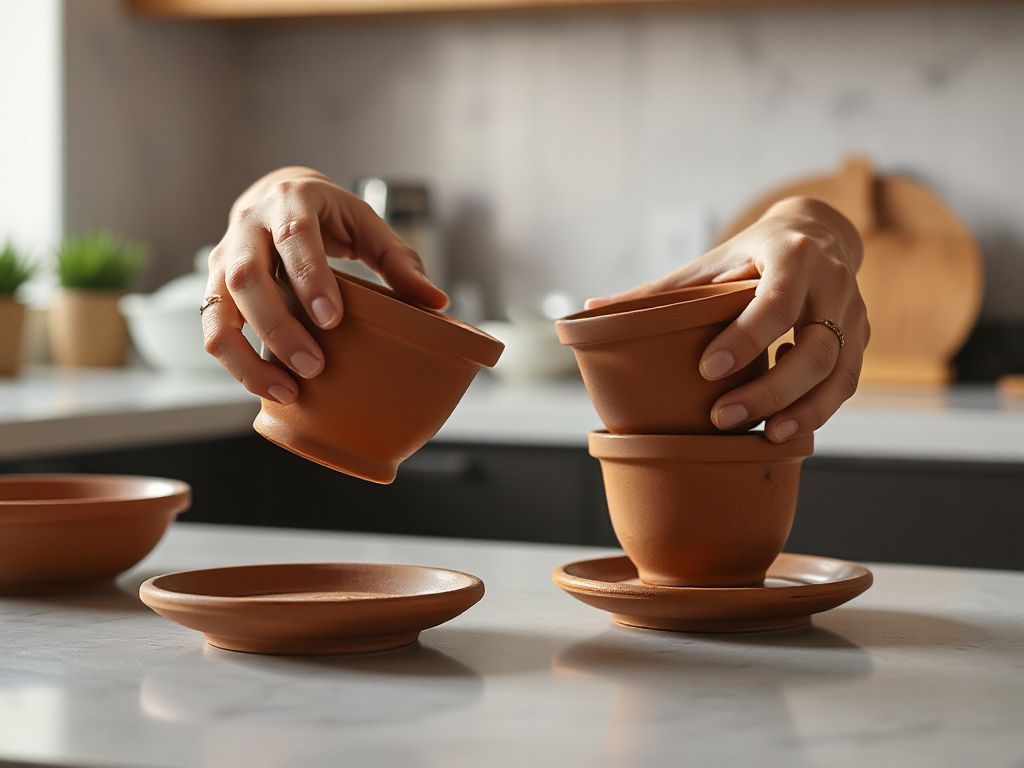
Why Every Plant Owner Needs to Understand Porosity and Seepage
Unglazed terracotta is thirsty. That’s a feature, not a bug. When you fill a terracotta pot with damp soil and place it directly on an unglazed saucer, water will travel through the pot wall and into the saucer, then into whatever surface sits beneath. Wooden tables, painted windowsills, even stone can stain if moisture lingers. I learned this the hard way on a light oak sideboard — a faint dark ring appeared after just two days. The solution isn’t to avoid terracotta; it’s to understand how it behaves and style accordingly.
Low-fired clay, like the classic Mexican terracotta, absorbs up to 15% of its weight in water. High-fired Tuscan terracotta is denser and less absorbent, but still porous enough to weep. If you see a saucer that stays damp on the outside even when the inside is empty, that’s the clay breathing. If you’re styling a console table or bookshelf, consider placing the entire setup on a tray of white resin flower pots or similar materials if the contrast fits your decor — but that’s a separate aesthetic. For pure terracotta, a protective barrier under the saucer is non-negotiable. I keep a stack of thin cork rounds and small felt pads for exactly this reason. Cork isolates the moisture without trapping it against the clay, and the pad adds just enough air gap to prevent condensation buildup.
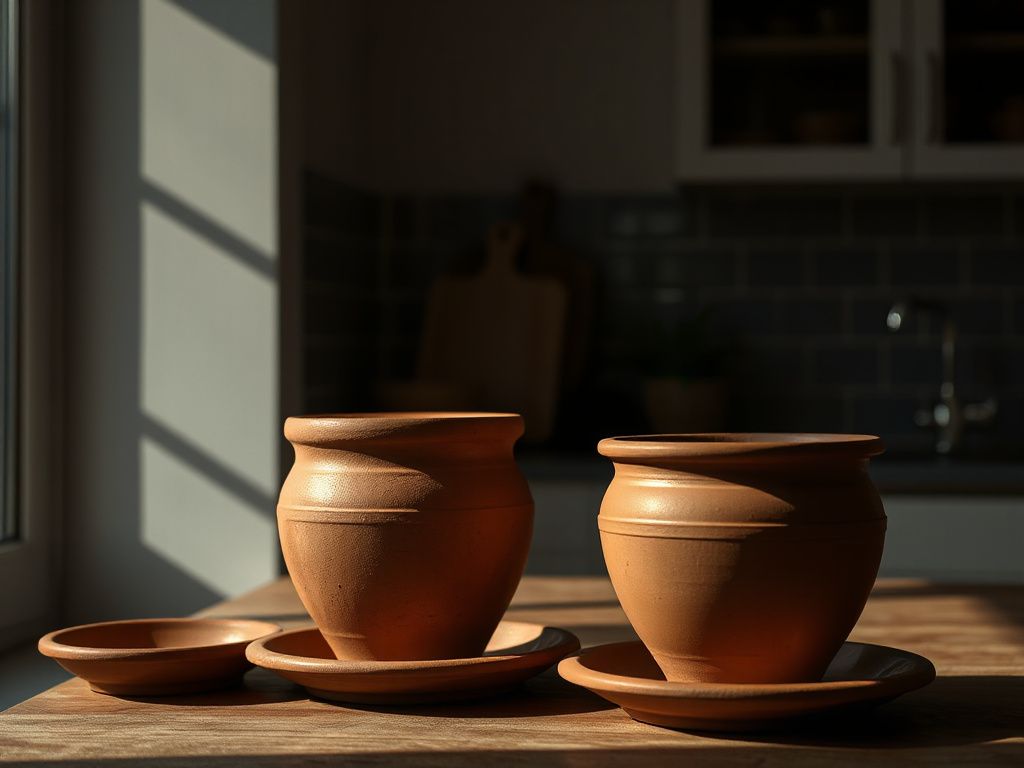
The Right Way to Use Terracotta Pots with Saucers Outdoors
Outdoor terracotta faces bigger challenges: freeze-thaw cycles, relentless sun, and rainfall that can fill a saucer in minutes. Many gardeners ask if terracotta pots with saucers can survive winter. The honest answer: only if they are labeled frost-proof and you take extra precautions. Standard low-fired terracotta is not frost-resistant. When water saturates the clay and then freezes, it expands—causing spalling or outright cracking. I’ve lost three beautiful Tuscan pots by leaving them outside one February after a heavy rain. Each time, the saucer cracked first because it held a puddle of ice.
Steps to Winterize Terracotta Saucers and Pots
- Empty all saucers completely before the first frost. Even a small amount of standing water can freeze and expand, cracking the clay from the inside out.
- Lift pots onto pot feet or a wooden board so the drainage hole remains open and no part of the base sits in a puddle. This also allows air to circulate beneath the saucer.
- Wrap the pot (not the saucer) in burlap or horticultural fleece, but leave the saucer exposed so any moisture can evaporate freely rather than being trapped against the clay.
- If you must leave saucers mounted, coat them inside and out with a breathable masonry sealer. This reduces water absorption enough to survive light frosts but won’t make them fully impervious.
For containers that stay in shaded corners, like many shade garden pots, winter moisture evaporates slowly. That’s a danger zone. I always bring smaller terracotta indoors or into an unheated garage where temperatures stay above freezing. Larger fixed planters can often sit directly on bare ground without saucers in winter—the soil itself acts as a wick—but then you lose the visual tidiness of the saucer until spring.
Solving the Most Annoying Saucer Problems: Algae, Stains, and Cracks
Terracotta saucers develop character fast. Some of it is charming; some of it is a slimy green mess. Algae growth happens because the saucer is damp and receives light—two things algae adore. To stop moss and algae from colonizing your saucer, I adjust two variables: light exposure and drainage time. If you water thoroughly until 10–15% of the water drips through, leave the saucer filled for no more than 20 minutes, then pour off the excess, you deprive algae of the sustained moisture it needs. For pots in bright windows, that tiny intervention works wonders. For outdoor pots in full shade, you might need to scrub the saucer with a mild vinegar solution once a month.
Mineral deposits, that chalky white film, are simply calcium and salts from hard water left behind after evaporation. They don’t hurt plants, but they can make a beautiful terracotta set look unkempt. I use a mixture of one part white vinegar to three parts water, applied with a stiff-bristle brush, to dissolve the buildup. Never use a pressure washer on unglazed terracotta. The high-pressure water erodes the soft clay surface, opening micro-fractures that eventually become cracks. For stubborn deposits, a paste of baking soda and water, left to sit for 15 minutes before scrubbing, lifts the residue without damaging the patina. If you’d rather avoid the maintenance altogether, consider styling with square nursery pots slipped inside decorative terracotta cachepots — then the functional saucer is hidden entirely.
How to Choose a Terracotta Saucer That Won’t Crack After One Season
The difference between a cheap terracotta saucer and a high-quality one isn’t just price — it’s kiln temperature and clay composition. Mass-produced saucers often use low-fire earthenware that shrinks unevenly during cooling, creating internal stresses that show up as hairline cracks within months. Higher-quality terracotta, particularly from Italian or certain Mexican workshops, undergoes a slower firing process that vitrifies the clay just enough to increase strength while preserving some porosity. Visually, you can spot the difference: cheap saucers have a dull, powdery surface and irregular thickness; better ones feel denser and ring slightly when tapped.
The single most preventable cause of cracking is placing a saucer directly on an uneven surface, like a bumpy brick patio, and then loading it with a heavy pot. The saucer flexes microscopically until a crack propagates from a pressure point. A simple rubber mat or even a thin layer of sand spread under the saucer distributes weight evenly and absorbs movement. For indoor use, those self-adhesive silicone bumpers designed for furniture do the same job invisibly.
Should You Seal the Saucer to Make It Watertight?
Yes, in specific scenarios. If you’re using a terracotta saucer indoors on a surface that absolutely cannot tolerate moisture — such as an antique wood cabinet or a piano — sealing the entire saucer inside and out with a food-safe waterproof sealant eliminates seepage entirely. The trade-off: you lose the evaporative benefit. The saucer becomes essentially a glazed dish. For those who want the best of both worlds, I recommend sealing only the underside and the outer rim, leaving the inner bowl uncoated so evaporation still occurs while the outer surfaces stay dry. This technique works beautifully for staging plants in high-visibility areas like dining tables or open shelving without sacrificing plant health.
Watering Frequency When Using Terracotta Pots and Saucers
Because terracotta wicks moisture away from the soil, plants in terracotta pots — with or without a saucer — typically need watering more often than those in plastic or glazed ceramic. The saucer’s presence doesn’t change that directly, but it does give you a visual cue. When I water, I pour slowly until I see the first trickle appear in the saucer. That tells me the soil is saturated. I then wait exactly 10–15 minutes to see how much water continues to drain out. If the saucer contains more than a thin film, I pour off the excess. If the saucer remains nearly empty after 15 minutes, I add a little more water. This rhythm adjusts with seasons: in winter, I might water once every 10–14 days; in summer, twice weekly for thirsty plants.
The key is never to let the saucer act as a constant water source. Some self-watering planter systems work on a wicking principle, but a standard open saucer is not designed for that — it leads directly to oxygen deprivation at the root zone. So, treat the saucer as a gauge, not a reservoir.
Styling with Terracotta Pots and Saucers Inside the Home
As a styling-focused reviewer, I see terracotta saucers as part of a larger visual story. Their warm, earthy tone anchors a grouping of plants and contrasts beautifully with dark foliage or bright white walls. A row of three identical terracotta pots on a long windowsill, each with a matching saucer, creates a rhythmic punctuation that feels both intentional and organic. I often mix heights — a tall cylinder pot on a low saucer, a shallow bowl pot on a slightly wider saucer — to avoid the monotony of a uniform set. The slight color variations between pots, from orange-rose to dusty pink, add depth that glazed planters can’t replicate.
For modern interiors where terracotta might feel too rustic, I’ll sometimes pair the pot with a sleek liner or a painted trim, but the unglazed saucer stays because its texture actually softens the hard lines of contemporary furniture. If you’re worried about the saucer looking utilitarian, stack two saucers of different sizes — a smaller one inside a larger one — to create a layered effect. Or, nestle the whole setup among other natural materials like woven baskets, wooden trays, or stone coasters. The goal is to let terracotta do what it does best: be a subtle, functional anchor that elevates the plant without screaming for attention.
Frequently Asked Questions
Can I leave my terracotta pot on the saucer permanently, or should I remove it between waterings?
Leaving the pot on the saucer is fine — as long as the saucer stays empty and the drainage hole is never blocked. I keep mine in place year-round because the saucer catches stray soil and drips after watering. Just check weekly that no roots have grown through the hole and into the saucer, which can plug it and create a miniature swamp.
How do I clean green algae off a terracotta saucer without damaging it?
Soak the saucer in a solution of one part white vinegar to three parts warm water for 30 minutes, then scrub gently with a natural-bristle brush. Rinse thoroughly and let it dry completely in direct sun — the UV light kills remaining algae spores. Avoid bleach, which can degrade the clay over time and leave a residue that might affect sensitive plants.
Why does my terracotta saucer crack even when kept indoors and not exposed to freezing?
Indoor cracks typically come from thermal shock or mechanical stress. Pouring ice-cold water into a warm saucer can cause rapid contraction and hairline fractures. Similarly, if the saucer rests on an uneven surface and supports a heavy pot, weight concentrates at a single point. Always place saucers on a smooth, flat surface and let water come to room temperature before watering.
This deep understanding of terracotta pots with saucers transforms a simple container into a reliable, long-term partner for your plants. When you read the porosity, respect the drainage, and style with intention, those warm, earthen discs beneath your plants become far more than just protective trays — they become the punctuation that holds the whole room together.
