

Why do so many metal trough planters end up as rusty, root-rotted disasters within the first season? I’ve lost count of the ones I’ve revived—or mourned—because someone forgot that the metal isn’t just a rugged container. It’s a heat conductor, a drainage dictator, and a long-term chemistry experiment all rolled into one. I’ve built and maintained dozens of metal trough planters for clients and my own garden, and the single thing newcomers miss is that the metal’s thermal conductivity isn’t a decoration—it changes your watering schedule and plant choices. A galvanized trough in full sun can push soil temperatures 10–15°C higher than a wooden box, so you need to pick heat-tolerant plants and add a thick mulch blanket, or you’ll wonder why your lettuce bolts after a week. That’s the difference between a working trough and a death trap.
Whether you’re eyeing a Corten steel beauty or a simple galvanized stock tank from the farm supply store, getting it right from the outset means you’ll spend more time harvesting basil than scrubbing rust. Let’s break down what nobody tells you about metal trough planters, because the details here aren’t just cosmetic—they’re the line between a planter that thrives for a decade and one that fails by July.
Key Takeaways
- A metal trough planter’s biggest hidden variable is thermal conductivity—full sun can bake roots, so mulch and heat-tolerant plant picks are non-negotiable.
- Drainage holes must be at least 12 mm in diameter and spaced every 20–30 cm, or you’ll get standing water that corrodes the metal and drowns roots.
- Galvanized steel is safe for edibles only if you monitor soil pH (keep it above 6.0) or line the interior to prevent zinc leaching.
Getting Started: Your First Metal Trough Planter
Picking the Right Material for Your Climate and Plants
Not all metal troughs are created equal, and the alloy you pick dictates how many seasons you’ll get before corrosion shows up. Galvanized steel—typically sheet steel coated with zinc conforming to ASTM A653—is the workhorse for budget-friendly planters. The zinc layer sacrifices itself to protect the steel beneath, which is why you see that silvery bloom on new stock tanks. In dry climates, this can last 10 years or more. In coastal salt air or constantly wet soil, you might see red rust in three. Corten steel (often sold under the trade name Cor-Ten) is the designer’s choice—it rusts on purpose to form a dense, protective patina that stops further corrosion. But that first-year runoff will stain anything nearby a amber-orange, so placing one on a light-coloured patio is asking for a permanent watermark. Stainless steel (type 304) is practically corrosion-proof but costs three to five times as much per linear metre, and it’s so non-porous that drainage becomes even more critical. Aluminum troughs are lighter and won’t rust, but they dent easily and lack the weight that keeps a tall planter from toppling in wind. The metal you choose decides your maintenance load for the next decade.
Essential Drainage Setup: Hole Size, Number, and Placement
I once dug out a client’s rosemary that had turned into a swampy mess—the trough had two tiny 6 mm holes in the centre, and the rest was a sealed steel basin. That rosemary drowned in a puddle of its own condensation. The rule I follow, and one every gardener should tattoo somewhere memorable, is this: drill holes at least 12–15 mm in diameter, spaced roughly every 20–30 cm across the base. For a 1-metre-long trough, that means five to six evenly spaced openings. A 2-metre trough might need eight to ten. And do not rely on a single row down the middle—add a couple of holes near the ends, because water pools unevenly if the planter sits even slightly off-level. Use a cobalt or titanium step-drill bit on steel; a standard high-speed bit will burn out after two holes. Deburr the edges so they don’t slice your hands later. If you can’t drill the bottom without damaging a decorative finish, drill the lower sides about 5 cm up from the base. That 5 cm of residual water acts as a tiny reservoir for roots to tap into during hot afternoons, but it drains fast enough to prevent perpetual sogginess. The difference a proper drain grid makes is the single most decisive factor in whether a metal trough planter succeeds or fails.
To Line or Not to Line: Interior Barriers and Soil Depth
Lining the inside of a metal trough with a barrier layer is a divisive topic, but it comes down to what you’re growing. For ornamental plants in neutral to alkaline soil, you can often skip it. For acid-loving plants—blueberries, azaleas, rhododendrons—or for any edible crop where you’ll be keeping soil pH low, a liner is mandatory. Acidic soil (pH below 6) accelerates zinc leaching from galvanized surfaces, and while zinc is an essential plant micronutrient, excess levels can harm root systems and, in the case of leafy greens, accumulate in tissues. I line with a single layer of heavy-duty pond liner or 1.5 mm polypropylene, cut to fit the interior walls and base before piercing it over the drainage holes. Don’t use landscape fabric alone; it wicks moisture and traps it against the metal. The liner also provides a thermal buffer—reducing the direct metal-to-soil heat transfer by a few degrees. One detail often overlooked: if you line, you must ensure the liner itself doesn’t create a secondary sealed pocket. Overlap the drain holes perfectly, and slit the liner over each one. A watertight plastic sack inside a metal box defeats the whole purpose of having drainage.
A firmly packed full 1-metre trough with saturated soil can weigh north of 200 kg, so whatever base you set it on must be able to bear that load without sinking. For alternatives to heavy ground-level planters, a hanging planter box offers a lighter way to add vertical greenery. But for metal troughs, a concrete slab or tightly set pavers are the only safe bets; turf, loose gravel, or timber decking will shift over time and leave your planter leaning like a crooked fence post.
Managing Heat and Watering for Healthy Plants
Why the Metal’s Temperature Spikes Matter More Than You Think
Metal is an exceptional thermal conductor, and that’s a blessing when you’re trying to warm soil early in spring, but a curse from June onward. I’ve measured surface temperatures on the south-facing side of a charcoal-coloured galvanized trough at 60°C on a 35°C day, while an adjacent cedar box stayed at 42°C. The soil just inside the metal wall gets similarly hot, baking the fine root hairs that do the heavy lifting of nutrient uptake. The result is a plant that wilts even with moist soil—because its roots are effectively being cooked. This is not a subtle effect. The 10–15°C soil temperature swing I mentioned in the opening is not an exaggeration; it’s something I’ve checked with a soil thermometer in at least a dozen planters. The solution is twofold: shading the body of the planter itself, and shading the soil surface. A thick 8–10 cm mulch layer of straw, shredded bark, or even coarse compost will drop the soil temperature right beneath it by several degrees. For larger troughs, I’ve attached exterior wood slats to the sun-facing side with brackets—creating an air gap that acts like a ventilated facade. It’s low-tech, but it works.
Adjusting Your Watering Schedule to the Metal’s Rhythm
The moisture loss from a metal trough isn’t just from evapotranspiration at the surface; the heated walls drive moisture out of the soil along the entire vertical profile. You’ll find the soil pulling away from the metal as it dries, creating a gap that lets water rush down the sides instead of soaking the root zone. I check moisture with a simple finger test twice a day in summer—morning and late afternoon—and rarely does a metal trough hold moisture as well as a wooden one. Drip irrigation on a timer is the most reliable fix; a ring of 2-litre-per-hour emitters spaced every 25 cm around the interior provides steady, deep watering without wetting the foliage. For those watering by hand, soak slowly with a fine rose attachment, pausing after each pass to let the water absorb laterally. If you see pooling on top, the soil surface has likely crusted over from the heat; lightly scratch it with a hand fork before watering again. This is not a container you can ignore for a week in July and expect happy plants.
Plant Choices That Don’t Flinch at Hot Roots
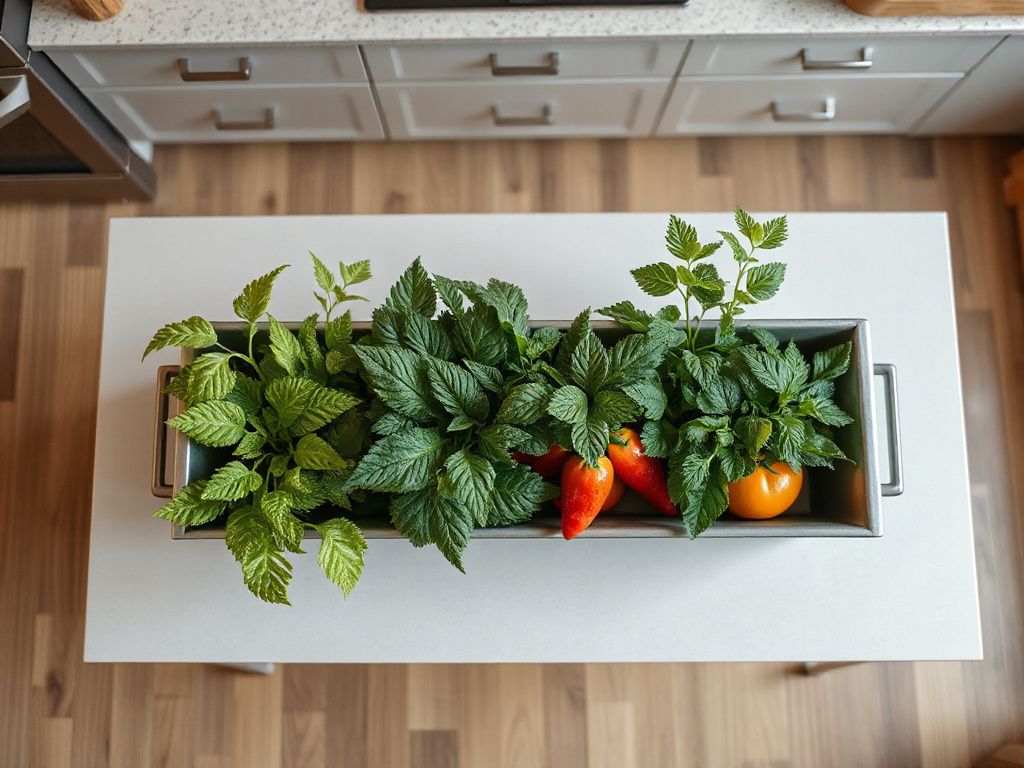
Some plants were made for these conditions. Mediterranean herbs—rosemary, thyme, oregano, sage—thrive when their roots stay on the toasty side, as long as drainage is impeccable. Succulents and sedums handle the heat with aplomb. For edibles, look to chard, amaranth, eggplants, and hot peppers; they demand warmth and will produce more robust harvests than they would in cooler soil. Lettuce, spinach, and peas, on the other hand, are a fast track to bolting and bitterness. One of my go-to combinations for a sunny metal trough is a central row of bronze fennel for height, surrounded by trailing rosemary and heat-tolerant sedum ‘Angelina’, which spills over the rim and shades a portion of the metal. It’s a design that addresses the heat problem with plant structure, not just afterthought shade cloth.
Long-Term Care: Rust, Weight, and Customization
Stopping Rust Before It Starts—and Fixing It When It Does
Rust is inevitable on anything not stainless or aluminum, but it doesn’t have to be terminal. For galvanized troughs, the enemy is localized zinc depletion. Scratches from sharp-edged gravel or tools expose the steel underneath, and once red rust appears, it will spread under the zinc layer like rust under paint. I inspect for bare spots every autumn, scrubbing them with a stainless steel brush and applying a zinc-rich cold galvanizing spray (95% zinc content) over the cleaned area. This sacrificial coating will protect the surrounding steel. For Corten, the rust layer is the protection, but if water pools constantly against the base, that patina can become flaky and non-protective. Never set a Corten planter directly on soil where the bottom rim stays damp; elevate it on rubber feet or a steel stand with an air gap. When welding custom troughs, hot-dip galvanizing to AS/NZS 4680 standards ensures a thick, bonded coating that standard spray can’t match. If you’re repainting a galvanized trough, the surface must be etched with a phosphoric acid-based metal prep first, or the paint will peel in sheets within one season. Then use an epoxy-based metal primer followed by a direct-to-metal topcoat. Caring for metal finishes outdoors isn’t limited to planters—our guide to metal wall candle holders covers similar rust-proofing techniques that translate directly to planter maintenance.
Those Strange White Powdery Spots—and What They Mean
If you’ve noticed a chalky white deposit on the outside of your galvanized trough, particularly after rain, that’s zinc oxide and zinc carbonate—the initial stages of the zinc’s protective “white rust” layer. It’s not harmful to the planter’s structural integrity in moderate amounts, and it will often mellow to a uniform grey patina. But heavy white rust, especially thick, fluffy deposits, indicates that the zinc was stored in a tightly packed, humid environment before it was sold, and the coating is already compromised. You can scrub off light white rust with a vinegar-and-water solution (one part white vinegar to four parts water) and a stiff nylon brush. Rinse thoroughly afterward. Do not use steel wool; it embeds iron particles that rust and stain. If you see red rust beneath the white powder, the zinc layer has failed, and you’ll need the spot treatment described above. The white powder itself is not toxic, but it can be alkaline—so wear gloves if you’re sensitive.
Adding Legs and Raising the Planter for Drainage and Backs
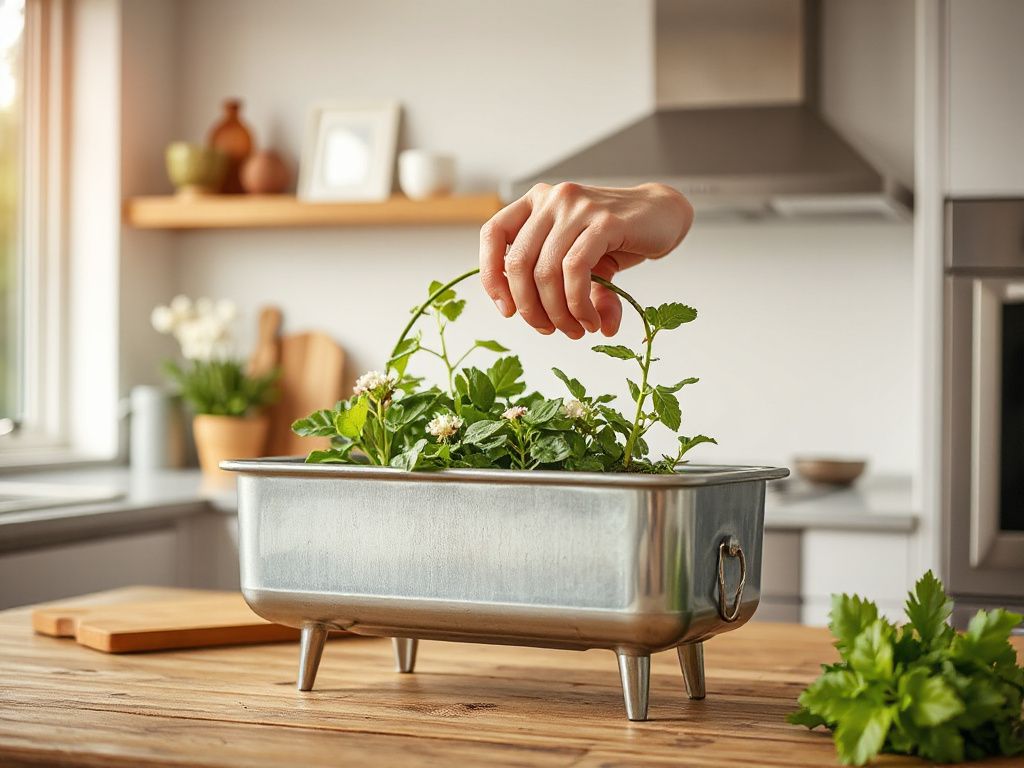
A metal trough planter belonging to a friend started out flat on her back deck. Within two months, the decking beneath it rotted from never drying out, and the trough itself developed a rust line exactly where it met the wet timber. Elevating the planter is not optional; it’s a non-negotiable piece of the drainage equation. A 2–3 cm air gap beneath the base allows water to escape freely from the holes, prevents organic debris from plugging them, and stops the metal from sitting in a permanent damp zone. For smaller troughs, you can bolt on pre-fabricated steel legs or attach furniture-grade stem castors with locking mechanisms if you’ll ever need to move it. For larger troughs, I build a simple cradle from pressure-treated timber or angle iron that raises the base at least 5 cm. Troughs that come with factory-welded legs often have a reinforced frame to take the point load; if you’re adding legs yourself, spread the weight with a horizontal plate or bracket so you aren’t punching a leg through the thin steel. Welding directly to the bottom can compromise the zinc coating and invite rust at the joint, so bolted connections or a separate external frame are safer. For indoor use where a metal trough acts as a statement piece, a metal pendant lamp shade can complement the industrial feel—just keep the planter on a waterproof tray.
Edible Gardening in Metal Troughs: Is It Safe?
This is the question I get more than any other, and the answer is nuanced but reassuring. Galvanized steel contains zinc, and zinc can dissolve into acidic soil. For most vegetables, soil pH maintained above 6.0 keeps zinc solubility minimal, and plants do not absorb dangerous amounts. The University of Minnesota Extension notes that galvanized containers are widely used for growing vegetables without issue, provided the soil is not excessively acidic. If you’re growing acid-loving crops, line the interior with a food-safe plastic sheet and fill with a pH-adjusted potting mix. Test the soil pH with a calibrated meter every few months—if it dips below 6, zinc leaching accelerates. In practice, I’ve grown tomatoes, basil, and peppers in unlined galvanized troughs for years with soil pH around 6.5 and never seen a problem. The white rust on the outside is external and not in contact with the root zone. Corten steel has no zinc, so the risk is essentially zero, though you may get iron oxide particulates near the soil surface, which are harmless. Stainless steel type 304 is completely inert for food gardening. So yes, you can grow a salad bar in a metal trough—just respect the pH.
One last structural note: the weight isn’t just about the base. A full 1.8-metre Corten trough can exceed 280 kg when the soil is saturated after rain. That’s not something you casually shift. If you’re placing it on a balcony, check the load rating of the structural slab first. A structural engineer can calculate pounds per square foot; you don’t want to test it the hard way.
Frequently Asked Questions
Can I leave a metal trough planter outside all winter without it cracking?
Yes, unlike terracotta or ceramic, metal troughs resist freeze-thaw cracking. However, wet soil that freezes inside can expand and distort the walls if the planter lacks adequate drainage. Always ensure holes are clear before winter and consider tilting the planter slightly or covering it to minimize waterlogging. Galvanized and Corten steels are robust in cold; aluminum can become brittle in extreme sub-zero temperatures but remains usable. The greater concern is ice expansion splitting a liner that’s poorly drained.
How big a hole do I need to drill for drainage, and how many?
Drill holes 12–15 mm in diameter every 20–30 cm along the base. For a 1-metre trough, that means 5–6 holes; a 2-metre trough needs 8–10. Place a couple near the ends to prevent water pooling at the edges. Larger holes clog less easily than small ones, and adding a layer of coarse gravel over the holes, beneath the soil, helps maintain flow. Never rely on a single central drain—it’s the quickest path to root rot.
What’s the difference between Corten and galvanized troughs for plants?
Corten steel forms a stable rust patina that protects the metal, requiring no paint and developing an amber-brown finish over 6–12 months. It stains adjacent surfaces during this period and costs more. Galvanized steel has a bright zinc coating that forms a grey patina; it’s cheaper, lighter, and resists rust until the zinc is scratched or depleted. For aesthetics, Corten offers a warm, industrial look; galvanized is more utilitarian. Drainage and weight considerations are similar.
