

A shelf that looked flawless the day you hung it can pull straight out of the drywall three months later, taking a chunk of plaster and a favorite pot with it. The culprit is almost never bad luck. It is wet soil, which roughly doubles the weight of every pot the moment you water, so the anchor rated for the empty display was never rated for the planted reality.
That single miscalculation is why plant shelves fail more often than any other decorative shelving in a home. Understanding why they behave differently from a bookshelf is the whole game, and it starts before you pick a single board.
Key Takeaways
- Design for wet weight, not dry. Saturated soil can double a pot’s weight, so size your shelf and anchors for the fully watered, mature state.
- Material has to survive water. Sealed hardwood, rot-resistant cedar or teak, and powder-coated steel hold up; bare wood and MDF swell, warp, and grow mildew.
- Anchoring must match the wall. Toggle bolts for hollow drywall, masonry anchors for brick, and screws into studs whenever the load is real.
- Light dictates placement. Usable light drops off fast with distance from the window and height off the floor, so plan spacing and supplemental grow lights around that gradient.
Why a Plant Shelf Is a Wet, Moving Load
The core distinction most people miss is simple. A plant shelf is a wet, dynamic load, not a bookshelf, so the design problem is managing saturated pot weight, dripping water, and shifting light all at once. Material choice and mounting method flow directly from those three forces rather than from how the shelf looks empty.
Books sit still and stay dry. Plants drink, drip, lean toward the sun, and get heavier as they mature. The shelf that looks perfect on install day behaves completely differently once the soil is soaked and the pothos has tripled in size.
Wet soil is the number one reason shelves collapse
Here is the figure that catches people off guard. A dry 10-inch pot of potting mix might weigh 4 to 5 pounds; saturate it and that same pot can hit 9 or 10 pounds. Multiply that across a shelf of six pots and you have added 25 to 30 pounds the instant you finish watering.
Always spec the shelf and its anchors for the saturated, mature weight, never the dry display weight. This is the exact gap that turns a solid-looking bracket into a slow-motion failure over a few watering cycles.
Metal fatigue and wood creep are real. A load that a bracket holds fine on day one can cause gradual sag and pullout when applied and released hundreds of times as you water and the soil dries.
Water has to go somewhere
Every time you water, excess runs out the drainage holes. Without a saucer, tray, or a raised lip on the shelf, that water lands on the shelf below, streaks down the wall, or pools on the floor.
Humidity trays and drainage saucers are not accessories here, they are part of the structure. They protect the surface, the wall, and the flooring, and they keep the shelf itself from sitting in standing water that rots or corrodes it.
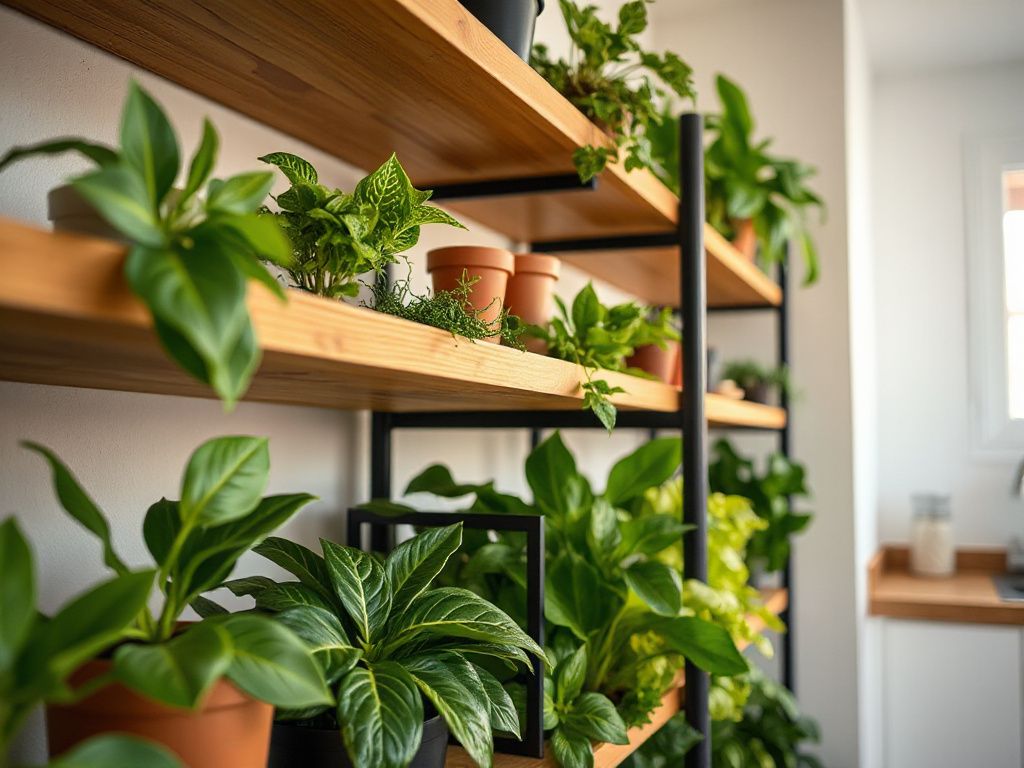
Choosing a Material That Survives Constant Watering
The split between a shelf that lasts a decade and one that warps in a season is almost entirely material and sealing. Water is patient, and it finds every unsealed edge and end grain.
Wood: seal it or pick a rot-resistant species
Bare wood and untreated MDF are the worst offenders. MDF in particular acts like a sponge: a single overflow swells the fibers, the surface lifts, and mildew follows in the humidity around plants. Sealing is not optional for a planted wooden shelf.
- Baltic birch plywood is dimensionally stable and strong for its thickness because of its many thin, void-free plies, but the exposed edges must be sealed since plywood wicks water through end grain fast.
- Teak and cedar contain natural oils and tannins that resist rot and insects, which is why they are standard for outdoor furniture and hold up to humidity with minimal treatment.
- Waterproof polyurethane gives a hard indoor film; for anything near constant moisture or outdoors, a marine-grade sealant or spar varnish flexes with the wood and handles UV without cracking.
Seal all six faces, not just the top. Water reaches wood through the bottom and edges more often than the visible surface, and an unsealed underside is where warping quietly begins.
Metal and wire options
Powder-coated steel handles moisture well as long as the coating stays intact; the weak point is any chip or scratch that exposes bare steel to water and starts rust creeping under the finish. Touch up chips promptly.
Galvanized shelving like the IKEA HYLLIS and similar units resist corrosion through a zinc coating and shrug off drips, which makes them a sensible cheap starting point. Wire greenhouse shelving and baker’s racks earn their place too, since open wire lets water drip through to a tray and lets air circulate around foliage. If you want the cleaner look of a dedicated stand rather than utility shelving, our rundown of galvanized plant stands covers how those finishes hold up around water.
Bathroom versus dry sunny window
Room conditions change what is safe. A steamy bathroom keeps materials damp for hours after every shower, so anything but sealed hardwood, rot-resistant species, or coated metal will eventually mildew or swell there.
A dry, sunny window is easier on the material but harder on finishes, since direct sun degrades many indoor polyurethanes and fades some woods. Match the shelf to the room, not just to the plant.
Anchoring So It Never Rips Out
This is where the wet-weight math becomes a safety issue. A shelf pulling out of the wall does not fail gently; it fails all at once, usually right after watering when the load peaks.
Read the wall first
Your fastener has to match what is behind the drywall. Guessing here is how anchors tear loose.
- Find the studs. Run a stud finder across the wall; in most modern homes framing sits 16 inches on-center, so once you find one, the next is usually a foot and a third away. Screwing directly into studs is by far the strongest option for a heavy planted shelf.
- Hollow drywall between studs needs toggle bolts, which open behind the panel and spread the load, rather than plastic expansion plugs that crush out under a swinging wet load.
- Brick or concrete requires masonry anchors and a hammer drill with a masonry bit; drywall anchors do nothing in these walls.
The U.S. Consumer Product Safety Commission tracks furniture and shelving tip-over and pullout incidents, and its guidance on anchoring loaded fixtures to structural framing applies directly to a shelf carrying saturated pots. When load matters, get into a stud.
French cleats spread the load
For a substantial shelf, a French cleat system is one of the most reliable mounts you can use. Two interlocking 45-degree strips, one on the wall and one on the shelf, distribute weight across a long horizontal run instead of concentrating it on two or three screws.
A French cleat screwed across three studs turns the entire wall section into the support, which is why cabinetmakers use it for heavy upper cabinets. It also lets you lift the shelf off to clean or reseal it, which matters more than people expect with plants.
Spacing, Light, and Why Plants Lean
Placement is governed less by aesthetics than by how quickly usable light drops off with distance from the window and height off the floor. Get the light gradient wrong and even perfect carpentry gives you pale, stretched plants.
Light falls off fast
Light intensity drops sharply as you move away from a window, both horizontally into the room and vertically as shelves stack. A plant that thrives 12 inches from the glass can starve three feet back on a lower shelf, even though the spot still looks bright to your eye, because eyes adjust and plants do not.
North-facing windows deliver the weakest light, south-facing the strongest in the Northern Hemisphere, with east and west somewhere between and peaking at different times of day. Map your window exposure before you decide which shelf gets which plant.
Why plants get leggy or lean
Legginess, those long stretched stems with wide gaps between leaves, is the plant reaching for light it is not getting. Leaning is the same signal, just directional, as the plant bends toward the brightest source.
Both mean the shelf placement or spacing is starving the plant of light. Rotate pots a quarter turn every week or so to keep growth even, and move chronically leggy plants to a brighter shelf rather than fighting the symptom.
Do high shelves need grow lights?
Often, yes. A high shelf far from the window frequently falls below what foliage plants need, and that is where a full-spectrum LED grow light earns its keep. Fixtures are rated by PAR (the light wavelengths plants actually use) and PPFD (how much of that light lands on the leaf), and higher shelves generally need a dedicated fixture on a timer to hit a usable number.
Energy-efficient LED options keep running costs low, and you can compare fixture efficiency using the U.S. Department of Energy’s guidance on LED performance and energy use before you commit to a setup. A cheap timer keeps the cycle consistent so plants get a predictable day length.
Shelf spacing for headroom and light
Two competing needs set your vertical spacing: plants need overhead room to grow, and lower shelves need light spilling in from the side. Cram shelves too close and the upper ones shade everything beneath them.
- Leave 12 to 18 inches of clearance for small trailing and compact plants.
- Allow 18 to 24 inches or more for anything upright or fast-growing.
- Stagger pots front to back so a tall plant does not throw a shadow straight down onto a shorter neighbor.
Arranging shelves near a window
Near a window, put the light-hungry plants high and close to the glass, and reserve lower and inner spots for shade-tolerant species. Keep the shelving itself from becoming a wall that blocks light to the plants below by using open wire shelves or narrower boards near the window.
Grouping plants by their light and water needs creates small microclimates on each shelf, which makes care far simpler than mixing a desert cactus with a thirsty fern on the same board. If a window setup is not giving you the space you need, wall-mounted systems open up vertical options, and our guide to the best wall plant systems this year walks through how those compare to freestanding shelving.
Build or Buy, Indoors or Out, and Keeping It Alive
The real cost difference
Building can cost less in materials but rarely as little as people hope once you count sealant, quality anchors, and hardware. A DIY sealed birch shelf might run you the price of the plywood plus a can of marine-grade finish and a set of toggle or cleat hardware, while a comparable ready-made unit bundles that into one price.
The honest tradeoff is control versus convenience. Building lets you size the shelf to your wall and seal it properly; buying saves you a weekend and usually comes with a stated load rating you can check against your saturated-weight math.
Taking shelves outdoors
Outdoor plant shelves change the rules in three ways: UV, weather, and wind. Sun degrades finishes and fades wood, rain keeps everything wet longer, and wind can turn a tall shelf into a sail.
- Switch to teak, cedar, or marine-grade sealed wood, or fully powder-coated or galvanized metal.
- Anchor tall units to a wall or fence so wind cannot tip them.
- Accept faster maintenance cycles, since outdoor finishes need reapplying more often than indoor ones.
Cleaning and maintaining a wooden shelf
Maintenance is what separates a shelf that lasts from one that quietly rots under the saucers. The trouble spots are always the same: under the pots, where water and mineral deposits sit unseen.
- Lift pots and wipe the shelf dry every few waterings; do not let saucers sit in standing runoff.
- Watch for white mineral crust or dark spots, which signal water is getting through the finish.
- Reseal high-wear areas once a year, or sooner outdoors, focusing on edges and any spot the finish has worn thin.
A quick note on adjacent options: if you are short on floor space entirely, adhesive shelving avoids drilling, though its low weight limits confine it to very small pots. Our complete guide to stick-on shelves covers where those actually hold and where they do not, which matters a lot once wet soil enters the picture.
Frequently Asked Questions
How much weight can plant shelves actually hold once the pots are full of wet soil?
Far less than the dry display suggests, because saturated soil can roughly double a pot’s weight. A shelf holding six pots that weigh 5 pounds dry can suddenly carry 55 to 60 pounds after watering. Always rate the shelf and its anchors for that saturated, mature-plant total, add the shelf’s own weight, and pick hardware with margin above the sum. Getting at least one fastener into a stud matters most here.
How do I keep water from dripping onto the shelf below or staining the wall?
Water needs a place to go, so build catchment into the design. Use drainage saucers or humidity trays under every pot, and choose shelves with a raised lip or open wire that drips to a tray rather than flat boards that let runoff sheet off the edge. Wipe standing water after watering, since pooled runoff is what stains walls, warps wood, and corrodes metal over time.
Do plants on a high shelf get enough light, or do I need to add grow lights?
It depends on distance from the window, but high and far-back shelves frequently fall short. Light intensity drops steeply with distance and height, and a spot that looks bright to your eye may be well below what foliage needs. If plants stretch, lean, or pale, add a full-spectrum LED grow light on a timer, checking its PAR and PPFD ratings to confirm it delivers usable light at shelf distance.
