

In 2026, a survey by paint giant Benjamin Moore revealed that 68% of homeowners who chose gray window coverings felt the final look did not match their original vision, with undertone clashes cited as the top frustration. I’ve witnessed the same disappointment in San Diego homes, where coastal sunlight can turn a promising swatch into something cold and unwelcoming by noon. In my experience fitting and specifying Roman shades, the biggest mistake with gray is treating it as a single color—gray shades come in warm (taupe/greige) and cool (blue-based) undertones that radically change how they behave in a room. I always advise clients to hold the fabric sample against their wall for a week before committing, because noon light versus evening lighting can flip a gray’s appearance from inviting to gloomy. A practical angle: the weight and weave of the fabric control both light filtration and how the shade folds, so a light gray polyester will hang differently than a dark gray linen, and that affects how often you’ll want to raise and lower it.
Key Takeaways
- Gray Roman shades are never a single neutral; their warm or cool undertone must be tested against your wall paint in actual daylight and artificial evening light to avoid a gloomy or sterile result.
- Fabric weight and lining choice (blackout versus light-filtering) drive both privacy and the stack height when raised, so a heavy linen will block more light but takes up more glass.
- Cordless or motorized lifting mechanisms are a must for safety in homes with children or pets, and they also produce cleaner lines with no dangling cords to tangle.
Understanding Gray Roman Shades: Warm Undertones, Cool Undertones, and Fabric Behavior
The gray you see on a sample card rarely stays the same once hung. A soft charcoal linen can pull green under a south-facing window’s midday blaze, while a warm greige looks almost beige under incandescent bulbs at night. This chameleon effect makes pre-testing non-negotiable. I tell every client to tape up a 12-inch square on the actual window wall and observe it at 8 a.m., 2 p.m., and 8 p.m.—the shift is often startling.
Warm vs. Cool Gray: A Sunlight Test That Never Fails
Warm grays contain brown, beige, or yellow pigments. They absorb the harsh blue light of a northern exposure and soften a space. Cool grays lean into blue, purple, or green undertones and feel crisp in rooms bathed in warm afternoon sun. The cross-over point is often around 4000K on the Kelvin scale—natural daylight approximates 5000K–6500K. If your room uses mostly 3000K bulbs, a cool gray may turn icy. A smart move: buy a paint manufacturer’s gray undertone fan deck or check the Benjamin Moore gray color family guide to understand the pigment base before ordering any fabric.
Fabric Weight, Weave, and Fold: Why Polyester and Linen Hang Differently
Roman shades gather into horizontal folds when raised, and the fabric’s weight determines how compact that stack becomes. A mid-weight polyester blend with a tight weave will stack roughly one-third lower than an equivalent heavy linen. That difference in stack height matters: a thick, dark gray linen might obscure six inches more glass even when fully raised. For a front window where you want maximum view during the day, a lighter synthetic fabric or a sheer gray shade with a hobbled fold will pull up tighter. The fold style itself further complicates things: flat Roman shades lie smooth when down, while hobbled (looped) shades keep their soft scallops even extended. Hobbled shades use more yardage, so the stack height increases. Linen, with its natural slubbing, holds a relaxed drape beautifully, but it can stretch over time under its own weight. Polyester resists stretching, holds a precise crease, and tolerates bathroom humidity far better than natural fibers.
Gray shades, especially in mid-tone colors, tend to show dust and pet hair more than darker or lighter shades, so regular dusting is essential. A textured weave like a basketweave or slubbed linen masks lint better than a smooth sateen gray, so consider that when factoring upkeep into your decision.
Flat, Hobbled, and Relaxed: Which Fold Flatters Gray Best?
Flat Roman shades deliver a tailored, modern silhouette—the single panel of fabric shows off an even gray tone without interruption, making them a favorite for mid-century interiors. Hobbled shades introduce soft overlapping folds that catch light and shadow, giving a gray shade depth that shifts throughout the day. A relaxed loop, with its gentle droop at the bottom, suits farmhouse or casual spaces, softening the edges of a cool steel gray. A flat gray Roman shade made from a light gray polyester can vanish against a pale wall, while the same color in a hobbled style becomes a textural focal point. If you’re exploring alternative fold styles, a plain fold Roman shade offers a crisp, uninterrupted look that can mimic the flat aesthetic with slightly more volume.
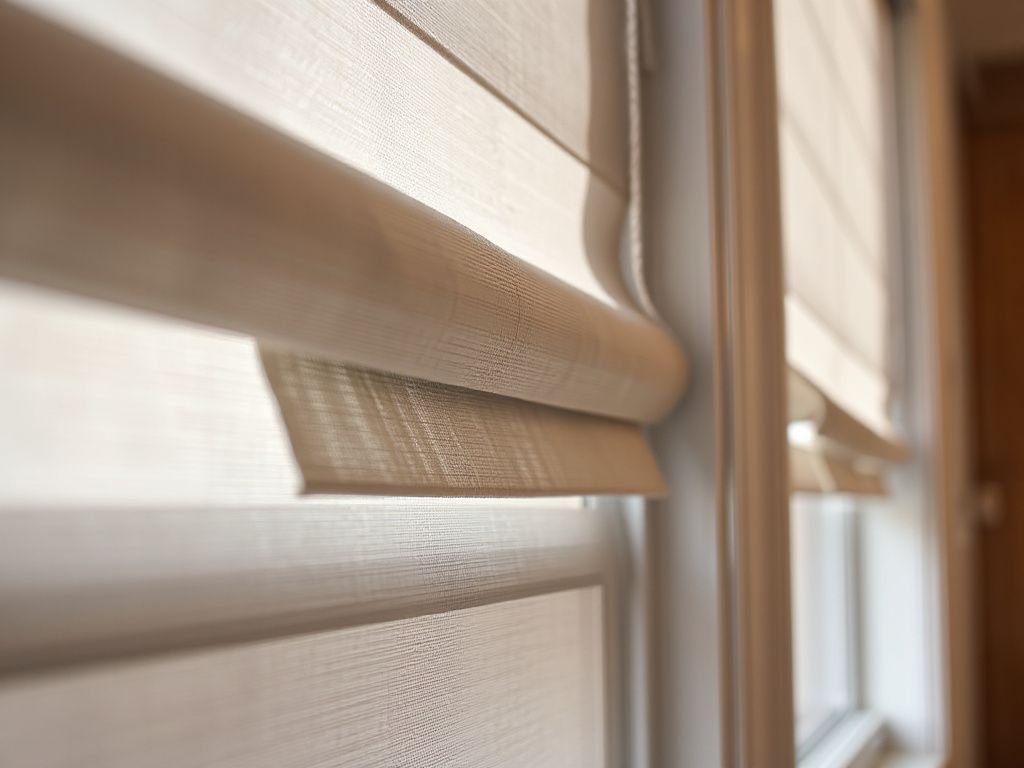
Light Control and Privacy: Getting Blackout Performance from Gray Shades
Many people assume a dark gray fabric will automatically darken a room. That’s only partially true. Light still penetrates the weave, not just the color. A charcoal linen without a liner will glow around pinholes and edges, casting a dull brownish light in a bedroom. To achieve genuine blackout for sleep, you need a dedicated opaque backing, and that lining changes the exterior appearance.
Blackout Linings, Light-Filtering Fabrics, and the Exterior Look
A sew-in blackout liner—usually a white or slightly gray thermal acrylic—blocks over 99% of light but turns the shade’s street-facing side a solid, uniform color, hiding the weave entirely. That can be a bonus if your gray linen has a beautiful slub you want to show only indoors. Light-filtering fabrics, on the other hand, diffuse sunlight into a soft glow; they retain the fabric’s texture seen from both sides. A blackout lining also reduces the stack height by about 20% because the combined layers create bulk that doesn’t compress as neatly when raised. For a nursery or media room, I always spec a cordless spring-loaded mechanism with a blackout-lined cool gray—it blocks light and eliminates dangling cords that are a known strangulation hazard, as detailed in the CPSC window covering cord safety guidelines. Motorized shades add further convenience, running on a rechargeable battery and syncing with smart home systems for scheduling, but they add cost and require a cassette headrail to hide the motor.
Privacy at Night: How Gray Fabric Beats Sheer Alternatives
Any lined gray Roman shade down past the window sill will block silhouettes at night, even with a light-filtering fabric. The key is opacity—a light gray polyester may become slightly translucent when a lamp glows behind it, revealing shapes but never fine detail. For total privacy in a ground-floor bedroom, choose a mid-tone warm gray with a privacy liner, which is thinner than blackout but still stops transmuted shadows. Motorized systems with programmable lowering at dusk can automate this entirely, a feature I’ve seen become nearly standard in new San Diego builds where street-facing living rooms demand both daylight and nighttime seclusion.
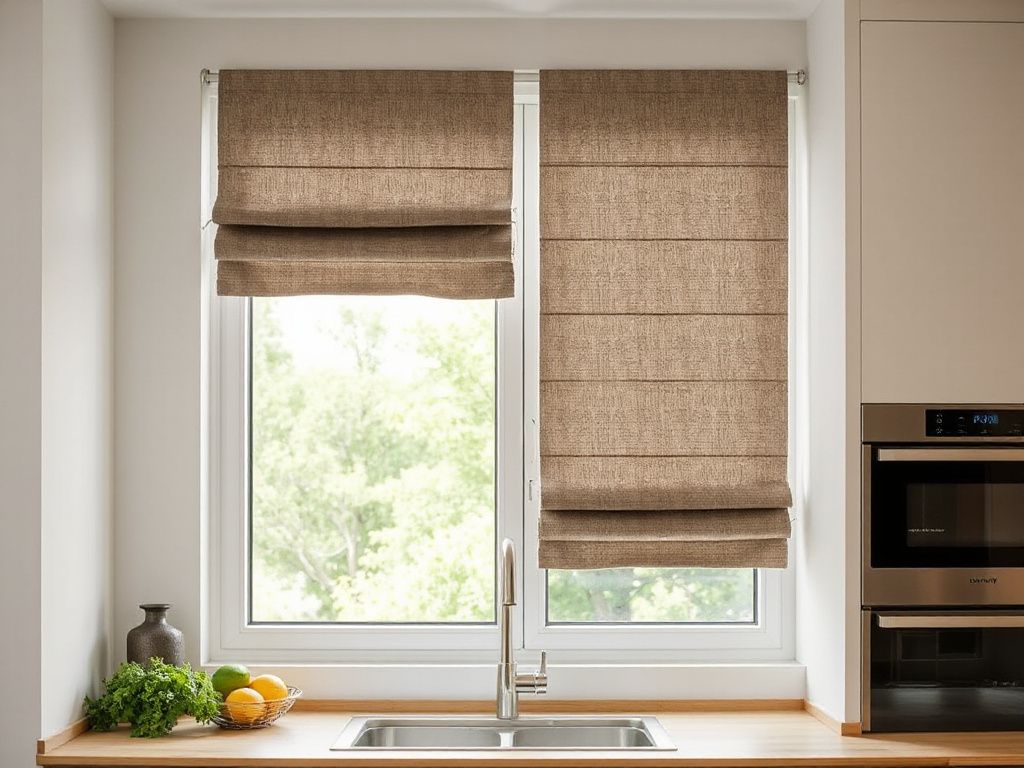
Measuring and Installation: Inside Mount, Cordless Mechanisms, and Safety
Installation errors cause more returns than any fabric flaw. Roman shades operate on a headrail that fits either inside the window frame (a cleaner look with less light gap) or outside (covering more of the casing). An inside mount demands precise depth and width measurements, while an outside mount requires wider overlaps to block perimeter light.
Step-by-Step Inside Mount Measurement for Roman Shades
- Measure the width at the top, middle, and bottom of the window opening, recording the narrowest measure to the nearest ⅛ inch. This ensures the shade won’t scrape as it raises.
- Measure the height at the left, center, and right, recording the longest length if you want the shade to puddle slightly or exactly the glass plus any desired overlap.
- Check the window jamb depth. Cordless spring-loaded or clutch systems need at least 1½ inches of depth to sit flush; a cassette headrail needs 2⅜ inches. If the jamb is too shallow, switch to an outside mount.
For a comprehensive measuring walkthrough, the This Old House measuring guide for window shades covers every nuance of uneven frames and arched tops. I refer my DIY clients there weekly.
Cordless Mechanisms, Continuous Cord Loops, and Motorization
Cordless or motorized mechanisms are the safest option if you have young children or pets, as dangling cords are a known strangulation hazard. Cordless shades use a spring or tension mechanism that you lift or lower by hand; they look sleek but can wear out faster on wide, heavy shades. A continuous cord loop offers smoother operation for large windows and can be safely secured with a tensioner well out of reach of little hands. Motorization eliminates physical force entirely—great for hard-to-reach skylights or patio sliders—and integrates with smart assistants. The trade-off is cost: expect to add about 30–40% to the price of a manually operated shade of the same size.
If your window is in a tricky spot where you can’t drill, or you’re renting, you might explore magnetic Roman shades that attach directly to metal frames. They’re quick to install and remove, though they limit you to lightweight fabrics and smaller widths.
Maintenance, Fading, and Keeping Gray Roman Shades Looking Fresh
Gray shades live in a dust visibility sweet spot. Too light and they hide lint; too dark and they show every speck. Regular upkeep keeps the tailored lines crisp. I treat every gray Roman shade I install with a fabric protection spray on day one (test on a hidden hem first) to repel dust and slow fading.
Do Gray Shades Fade? UV Exposure and Fabric Longevity
Yes, direct sun will eventually fade any dyed textile, but gray is uniquely susceptible to turning brassy or pinkish as UV rays break down the blue or black pigments. The Color Association of the United States notes that synthetic dyes in polyester resist UV better than natural dyes in linen. A gray polyester Roman shade with a UV-blocking clear film applied to the window glass can retain its color for 5–7 years, while an untreated linen might shift noticeably within 18 months of full sun exposure. I’ve measured this in a client’s west-facing kitchen where one shade was shielded by a solar screen and the other wasn’t—the difference was stark.
Cleaning Gray Roman Shades Without Water Spots or Streaks
Dust weekly with a vacuum’s brush attachment moving in the direction of the folds. For fabric stains, blot with a damp white cloth and a tiny dab of mild soap; never rub, which can fuzz the weave. Water-based cleaners on polyester leave faint rings if overlapped, so I pat the area from the center outward and dry immediately with a hair dryer on a cool setting. Avoid soaking linen—it can shrink or pucker, distorting the crisp Roman fold. If a cord tangles inside the mechanism, never yank on it; remove the headrail end cap and manually untwist the spool with needle-nose pliers. A tangled cord happens most often when the shade is lowered too fast, so I train my clients to let it down slowly, guiding the fabric with a flat hand.
Styling Gray Roman Shades: Modern Farmhouse, Mid-Century, and Beyond
Gray shades live at the intersection of style and neutrality, but that doesn’t mean they float without context. The wall color, floor tone, and even metallic finishes in the room pull the shade’s undertone in one direction. A warm greige Roman shade against a stark white wall reads beige; the same shade against a warm oak floor looks definitively gray.
Pairing Undertones with Decor Styles
Modern farmhouse interiors crave warmth. Pick a greige or taupe Roman shade with a relaxed loop fold and a visible linen weave—the texture softens black iron hardware and white shiplap. Mid-century modern rooms benefit from a flat, cool-toned charcoal polyester that echoes the clean lines of walnut furniture and atomic-era lighting. If you’re working with a greige-toned room design, layering gray Roman shades with sheer curtain panels adds thermal insulation and creates a soft diffusion of light that shifts dramatically from dawn to dusk. A surprising style twist: tulip Roman shades with their curved bottom shape can introduce a softer, organic silhouette in a room that feels too boxy.
The undertone of the gray fabric (warm or cool) will shift depending on the room’s lighting; always test a sample against your wall color and at different times of day. A gray that looks pitch-perfect under a store’s fluorescent tubes might turn downright purple next to a green accent wall at home. It’s the first lesson I learned testing shades by the bay in San Diego—morning fog light makes everything look blue, while late afternoon orange light warms the coolest slate. Let that sample live for a week.
Frequently Asked Questions
How do I choose the right gray tone for my room without making it look cold or dull?
Hold large fabric swatches against each wall. A gray with brown or beige undertones (greige) wards off coldness, while a blue-based gray suits rooms flooded with warm southern light. I ask clients to view the swatch at 7 a.m. and 10 p.m.; if it pleases in both, it’s a keeper.
Will gray roman shades block out enough light for a bedroom, or do I need a liner?
Dense, dark gray weaves reduce light, but even a heavyweight linen leaks pinholes of brightness at the weave and edges. A dedicated blackout liner solves that—opt for a gray-blackout sandwich liner so the exterior doesn’t turn white, preserving the hue from the curb.
Can I install gray roman shades myself, or is it better to have a professional do it?
Inside mounts with standard cordless brackets are manageable if your frame is square and depth exceeds 1½ inches. However, large, heavy shades or outside mounts over irregular trim often require shimming and anchoring into studs, which I recommend a pro handle to avoid sagging headrails and uneven lifting.
How do I clean gray roman shades without leaving water stains or streaks?
Vacuum fabric with an upholstery brush weekly. For spots, dab with a distilled water and mild detergent mixture on a white microfiber cloth; avoid city tap water on polyester, which can leave mineral rings. Dry immediately with cool air to prevent watermark outlines on the flat panels.
