

A mismatched grey undertone can make a beautifully designed room feel permanently unsettled. The rug you thought would anchor the space instead clashes with the wall colour, throws off the balance of your furniture, and makes you second-guess everything you know about your own taste. It sounds dramatic, but after years of designing with black and grey rugs, I’ve found that the biggest mistake people make is ignoring the undertone of the grey—whether it’s blue, green, or brown—because that single choice dictates whether the rug feels cold or warm in a room. Another thing I always tell clients is to think about pile direction: a shiny or crushed pile shows differently on a dark rug, so you can’t just assume it’s uniform. Finally, the practical reality is that these rugs are forgiving with spills but unforgiving with dust and pet hair, so choosing a fiber that’s easy to vacuum is more important than with lighter colours.
I’ve stood next to homeowners staring at a rug that looked perfect online but completely wrong once unrolled on their floor, and almost every time the culprit was an undertone they didn’t see in the showroom’s lighting. Understanding how black and grey area rugs behave under your specific conditions—and how to care for them without constant frustration—turns a risky purchase into a confident one.
Key Takeaways
- Grey rugs almost always carry a blue, green, or brown undertone that determines whether they read as cool or warm; identify it before you buy.
- Dark rugs hide spills well but announce every speck of dust, lint, and pet hair—select a fiber and pile texture that simplifies vacuuming.
- Pile direction and crush patterns on black rugs create visible unevenness; choose a rug with short, uniform fibers if you want consistent colour.
- Rug construction and backing directly affect longevity and indoor air quality; look for certifications like Oeko-Tex Standard 100 or GreenGuard Gold.
The Undertone Trap: Why Your Grey Rug Looks Blue
A grey rug is never simply grey. The human eye is remarkably sensitive to subtle colour shifts, and almost all grey dyes lean into a secondary hue—blue, green, or faint brown/taupe. In a store lit by cool fluorescent tubes, a blue-grey rug appears crisp and modern. Bring it home to a room bathed in warm afternoon light, and that same rug can reflect a chilly, almost clinical blue that fights against cream walls and honey-toned wood floors.
This isn’t a dye defect. Wool, cotton, and synthetic fibres all take colour differently, but the underlying tint is largely a design choice. Manufacturers deliberately add a small amount of pigment to create depth. The trick is recognizing which undertone you’re dealing with before you commit. One reliable method: take a pure white sheet of paper and hold it next to the rug sample near a window and under the room’s primary artificial light. The contrast reveals the hidden colour. If the grey edge looks even slightly blue or green against the white, that’s what will dominate once the rug covers a large area.
Cool vs. Warm Greys and How They Shift Your Room
Blue-greys and green-greys are cool. They partner well with silver metals, stark white walls, and black accents. But introduce warm wooden furniture or beige upholstery and the rug seems to separate from everything around it. Brown-grey or greige (grey-beige) rugs pull a room toward comfort. They soften the contrast, making them safer for eclectic spaces that mix different wood tones.
Lighting is the variable people overlook. Natural daylight changes throughout the day, and a blue-grey rug can shift dramatically between morning and evening. Artificial bulbs add another layer—a 3000K LED makes a cool grey turn muddy, while a 5000K daylight bulb can make a warm grey look washed out. When I work with designers, they often test a rug sample for a full 24-hour cycle before finalizing any purchase, watching how it responds to the room’s natural light path.
Machine-made rugs generally hold a more even dye lot, meaning the undertone stays consistent across the entire piece. Hand-knotted or hand-tufted rugs, on the other hand, often show slight abrash—intentional or natural colour variations that add character. That variation can either mask an undertone clash or amplify it, depending on the surrounding decor. If you want predictability, a machine-made rug made from solution-dyed polypropylene delivers the most uniform grey because the colour is built into the fibre during extrusion, not applied afterward.
Practical Durability: Dust, Pet Hair, and the Pile That Fools You
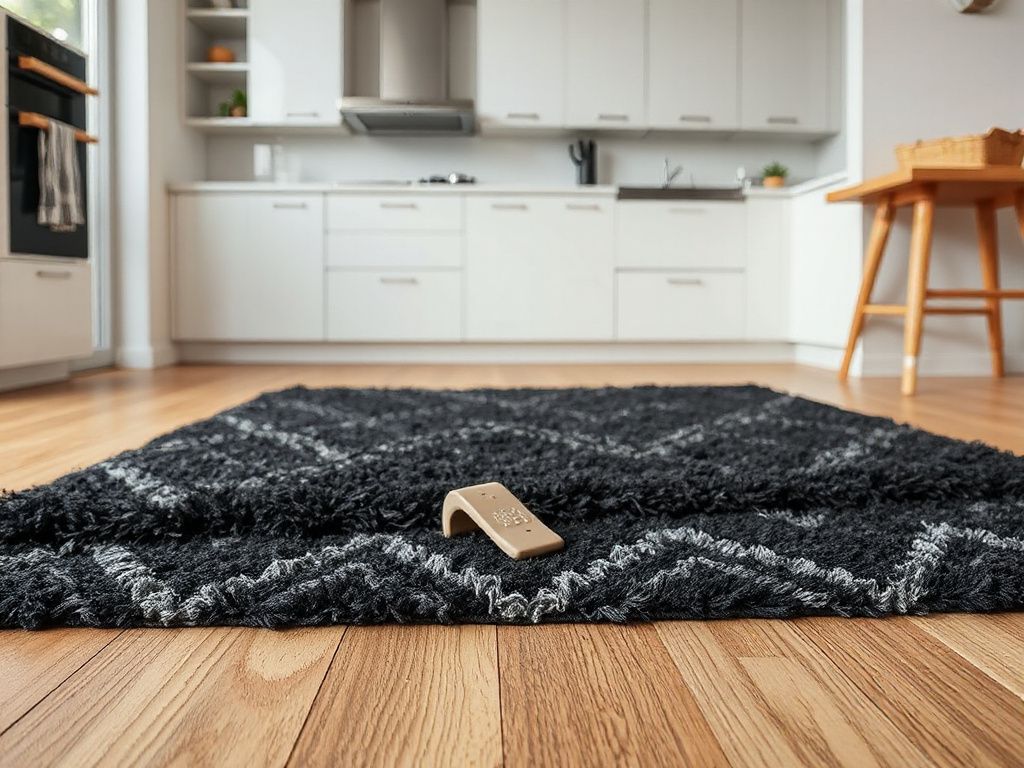
Spilled red wine on a black rug? Barely registers. A thin layer of household dust or a single white cat hair? Instantly visible. Black and grey area rugs behave in a high-contrast way: they forgive dark-coloured messes and highlight light-coloured debris. This single aspect dictates how you clean and how often.
Pile texture multiplies the effect. A cut-pile rug with a smooth, velvety surface shows footprints and vacuum tracks because the fibres reflect light differently when pushed in one direction. I’ve seen homeowners panic, thinking their rug is defective, when it is simply the pile laying flat after foot traffic. A short, dense loop pile or a textured flatweave avoids this problem almost entirely. For high-traffic rooms like living rooms, a low-profile loop construction made of wool or polypropylene gives you a consistent face that hides daily wear.
Fibre Selection: Wool, Synthetics, and Vacuum-Friendly Weaves
Wool is a champion at resisting crushing and naturally hides soil because its crimped structure scatters light. However, wool sheds and can hold onto fine pet hair that embeds into the scales of the fibre. A good suction-only vacuum (without a rotating beater bar) lifts that hair without pulling out extra wool fibre. Polypropylene and polyester repel moisture and resist staining, but they generate static that attracts dust and lint like a magnet. You will need to vacuum a synthetic rug more often, and a vacuum with a motorized brush roll works effectively on these fibres without damage—provided the rug is not a shag with long, tangled strands.
Pet hair on a dark rug demands a specific approach. A lint roller works on small spots but leaves adhesive residue if overused. A dampened rubber glove pulled across the surface collects fur in clumps. Handheld vacuum attachments with a bristle-free rubber nozzle also lift hair efficiently. For homes with multiple pets, consider a thick plush area rug that uses a tight loop pile—many of those designs keep hair near the surface rather than forcing it deep into the backing, making weekly cleaning a 10-minute task rather than an hour-long ordeal.
Deep-Cleaning and the Dark-Colour Reality
Dark rugs need deep-cleaning less for stain removal and more to extract the fine grey dust that settles into the base of the fibres and dulls the entire surface. I recommend a professional hot-water extraction cleaning every 12 to 18 months for wool rugs, and every 6 to 12 months for synthetic rugs in active households. Use cleaning solutions labeled pH-neutral and free of optical brighteners; alkaline cleaners can strip wool’s natural lanolin and cause colour fading. A rug carrying the Oeko-Tex Standard 100 certification ensures no harmful chemicals were used in production, meaning the dyes are less prone to bleeding during a deep clean.
Sunlight fading is another concern, though it hits darker rugs differently than light ones. A black area rug in a sun-drenched room will lose intensity slowly, turning slightly brownish over several years if made from natural wool. Solution-dyed synthetic rugs resist fading for longer because the pigment is bound into the polymer, not sitting on the surface. Still, rotating the rug 180 degrees every three months evens out any exposure across the entire field.
Construction Choices That Shape Long-Term Performance
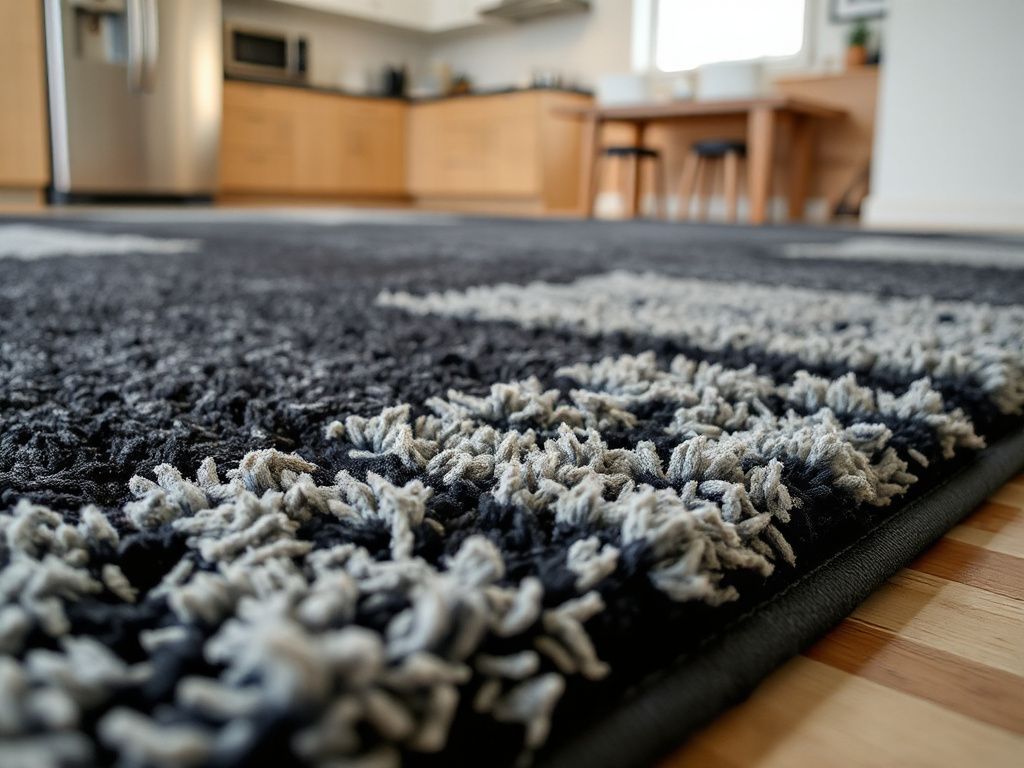
How a rug is built matters more than what it looks like in a catalogue. The construction method determines how evenly the colour reads, how the rug feels underfoot, and how well it handles daily abuse.
Hand-tufted rugs are made by punching yarn through a fabric backing with a tufting gun, then gluing a secondary backing over the stitches. The result is a plush, cut-pile surface that feels substantial. The grey tones in hand-tufted rugs often show slight variations because the wool batches can differ subtly. This is normal and expected. A GoodWeave certification on a hand-tufted rug guarantees it was made without child labour, a point that matters to many buyers once they realize how many handmade rugs lack ethical verification.
Machine-made rugs are produced on power looms, typically with synthetic fibres like polypropylene or polyester, though machine-woven wool rugs exist. The weave is perfectly uniform. A grey machine-made rug looks the same at the edges as it does in the centre. For people who want a clean, minimalist look with black and grey, that precision is a clear advantage. The backing on machine-made rugs is often cotton or a synthetic mesh, both of which breathe better than rubber and prevent moisture from becoming trapped between the rug and the floor.
Backing Materials and the Hidden Danger
Rubber backing on a cheap rug can crumble after a few years, leaving a black powdery residue on your hardwood floor that is difficult to clean. I have seen this damage call for a floor refinishing, not just a new rug. Cotton or polyester backing breathes, slides less when paired with a quality rug pad, and does not degrade into a mess. A rug pad also prevents the coarse underside of a flatweave or jute rug from scratching the finish. Choose a felt-and-rubber combination pad that grips the floor and cushions the rug, particularly on smooth surfaces like hardwood or tile.
Indoor air quality is another consideration. Both Oeko-Tex and GreenGuard Gold certifications indicate that a rug has been tested for low chemical emissions, including volatile organic compounds (VOCs). A synthetic rug without these certifications can off-gas for weeks, creating a noticeable smell that lingers in a closed room. This is especially relevant when you are placing a large 8×10 or 9×12 rug in a bedroom where you’ll spend eight hours breathing nearby.
Styling Without Clashing: Furniture, Layout, and the Right Size
A black and grey rug pulls a room together when it connects with at least one other element—whether that is the undertone in the wood floor, the cool metal of a floor lamp, or the textured fabric of a sofa. The rug cannot be an island.
Start by examining the dominant wood tones. Orange-toned oak floors lean warm, so a grey rug with a brown or greige undertone bridges the gap. Pale ash or maple floors skew cool, so a blue-grey rug feels intentional. Black furniture pairs with nearly any grey but will emphasise blue undertones if the rest of the palette is neutral. In a room with mixed metals, pull the rug’s secondary colour—perhaps the black or charcoal—into small accessories like picture frames or lamp bases. This creates visual rhythm without needing an exact match.
Pattern vs. Solid: What Hides Stains Better?
A solid black rug is the most dramatic choice. It also shows every footprint, piece of lint, and water spot. A rug with a subtle pattern—speckles, a faint grid, tonal stripes—camouflages daily debris far better. The pattern breaks up the continuous dark field, so your eye does not register every speck. Even a minimal diamond motif in charcoal on a mid-grey ground reduces the perception of dirt by half, in my observations, compared to a plain surface. This is a practical styling decision, not just an aesthetic one.
If you have pets or small children, a rug that already incorporates a distressed or heathered look will age gracefully. Spills and tracked-in dirt become part of the texture rather than a glaring flaw. For homes that demand absolute cleanliness, however, a low-contrast flatweave in alternating bands of black, charcoal, and silver cleans up quickly with a vacuum and occasional spot treatment.
Sizing and Underlay: The Foundation Nobody Sees
A rug that is too small undermines the entire layout. In a living room, the front legs of all major seating should rest on the rug’s surface. For a standard 8×10 or 9×12 black and grey area rug, measure so at least 12 to 18 inches of bare floor remain around the perimeter to frame the space. In a bedroom, a rug that extends 24 inches beyond the bed on both sides ensures your feet land on something soft, not a cold floor.
A flatweave rug on hardwood will slide unless it’s anchored. The correct underlay has a dense felt core that absorbs footstep pressure and a natural rubber bottom that grips the floor without chemically interacting with the wood’s polyurethane finish. I recommend a pad thickness of at least ¼ inch for low-pile rugs and up to ⅜ inch for thicker hand-tufted pieces. This prevents bunching, which is not only annoying but also a tripping hazard.
Layering rugs brings textural depth, and a black and grey flatweave can sit beautifully under a smaller plush rug in a rich charcoal. The key is staggering the edges so both rugs are visible. A common mistake is centering a small rug on a larger one and ending up with a target-like pattern that makes the floor look like a bullseye.
If your existing decor includes brown or tan elements that you cannot replace, think about how a black and brown rug might integrate those tones more organically than a pure grey. Sometimes the missing link is a colour you did not consider. And when you need a rug that can handle a covered patio or a sunroom where moisture and direct sun are factors, the materials you choose change completely; our black and white outdoor rug guide explains the durability thresholds you will need. These adjacent decisions shape the overall feel of a room far more than a single rug ever could.
Frequently Asked Questions
How do I remove pet hair from a dark rug without leaving it fuzzy?
Use a dampened rubber glove or a rubber squeegee pulled in short, firm strokes across the pile. The rubber creates static that lifts hair out of even tight loops without disturbing the fibre tip. For daily maintenance, a vacuum with a motorized brush roll set to the manufacturer’s recommended height works well on low-pile synthetics. Avoid beater bars on shag or wool rugs. A fabric softener sheet rubbed lightly over the surface reduces static cling between cleanings, limiting how much new hair sticks.
Why does my grey rug look blue in some lights? Is it a dye issue?
It is rarely a dye defect. Almost all grey dyes carry a subtle blue, green, or brown undertone that becomes visible under different colour temperatures. Cool white LEDs and north-facing windows bring out blue tones; warm incandescent bulbs hide them. To verify the true colour, view the rug under midday daylight next to a pure white reference. A rug certified by Oeko-Tex Standard 100 uses stable, tested dyes, but the undertone itself is a design feature, not a fault.
What is the best underlay to prevent slipping on a hardwood floor with a flatweave rug?
A combination rug pad with a natural rubber bottom and a compressed felt top works best. The rubber grips the floor without leaving chemical residue on the finish, and the felt layer adds cushion to prevent the flatweave’s coarse underside from scratching the wood. Look for a pad that is roughly 2 inches smaller than the rug on all sides so the edges stay hidden. For extra security on very smooth floors, a thin silicone waffle pad can be used, but ensure it is labeled as non-adhesive to protect the hardwood.
